
The Pisan salons: Emily Charlotte Ogilvie Beauclerk (1778-1832)
Nicoletta Caputo (University of Pisa)
Emily Charlotte Beauclerk, known as “Mimi”, was the daughter of the Duchess of Leinster and her second husband, William Ogilvie, and the half-sister of the Irish revolutionary leader Lord Edward FitzGerald (Crisafulli 2023, p. 28). Percy Shelley and his cousin Thomas Medwin had already met her in Sussex, since their families were neighbours. Beauclerk, the mother of thirteen children, had left her husband in Geneva to spend the winter of 1821-22 in Pisa with her seven daughters, almost all of whom were of marriageable age. Medwin provided a generous description of both the woman and the receptions that were held every evening at her home: “She was indeed a person of first-rate talents and acquirements, possessed an esprit de societé [sic] quite unique, and her house, which she opened every evening, was a never-failing resource” (Medwin 1913, p. 368). Her salon was the only private one where dance parties were also given, and, according to what Edward Williams wrote to Edward John Trelawny on 26 December 1821, behind such sociability lay a specific reason: “There is a Mrs. B[eauclerc] here, with a litter of seven daughters; she is the gayest lady, and the only one who gives dances, for the young squaws are arriving at that age when, as Lord Byron says, they must waltz for their livelihood” (Gisborne and Williams 1951, p. 160).
While Mary, on 16 December, had already noted in her journal that Medwin had gone to dinner at Mrs Beauclerk’s (M. Shelley 1987, p. 388), Percy mentioned his former neighbour for the first time on 31 December, in a letter to Claire – who lived in Florence at the time – in which he recounted having been to her house, stated that he was annoyed by her excessive effusions, and declared that he would not return to see her until she had visited Mary: “I have been once, after enduring much solicitation, to Mrs. Beauclerc’s, who did me the favour to caress me exceedingly. Unless she calls on Mary, I shall not repeat my visit” (P. B. Shelley 1964, p. 371). Mary’s first recorded visit to Mrs Beauclerk was, instead, on 23 January, and she went there accompanied by Trelawny, who had arrived in Pisa only a few days before (M. Shelley 1987, p. 392). Her journal records several other evening visits: on Thursday, 7 February; Friday, 1 March, and Tuesday, 12 March (M. Shelley 1987, pp. 395, 400, 401). Of particular interest is the ball on 7 February, which she attended, again, with Trelawny; on this occasion, in fact, we also find – an unusual occurrence in Mary’s journals – a long reflection that continues into the following day (and from which one page is cut), which was evidently inspired by the dance. The opening and closing sections are reported below:
During a long – long evening in mixed society, dance & music – how often do ones sensations change – and, swift as the west wind drives the shadows of clouds across the sunny hill or the waving corn – so swift do sensations pass […]. Sometimes I awaken from my ordinary monotony & my thoughts flow, until as it is exquisite pain to stop the flowing of the blood, so is it painful to check expression & make the overflowing mind return to its usual channel – I feel a kind of tenderness to those whoever they may be (even though strangers) who awaken the train & touch a chord so full of harmony & thrilling music – When I would tear the veil from this strange world & pierce with eagle eyes beyond the sun – when every idea strange & changeful is another step in the ladder by which I would climb the – (M. Shelley 1987, pp. 395-96)
As she wrote to her friend Maria Gisborne on 9 February, Mary found Trelawny’s company “delightful” because he “excit[ed her] to think” (M. Shelley 1980, p. 218).
It was this new acquaintance who escorted her to those parties that disgusted Shelley; as Trelawny’s biographer writes, “He went with her to the parties that Shelley abominated” (Grylls 1950, p. 75). In fact, Mary does not appear to have totally disliked balls, as can be inferred from the bitterness that seems to emerge from a letter she wrote to Maria Gisborne on 18 January 1822:
Pisa today ha cambiato viso; all was allegrezza, the Court here, balls &c. – when a brother of the Dutchess, a promising young man, has suddenly died of a mal maligno, so the Court has left us. The ladies look in despair at their new gowns, the gentlemen, among them Medwin, sigh to think of the wal[t]zing they might have had. – Oh plaisir! one long adieu! – You know us too well not to know that we have not lost any thing by this change – I had thought of being presented, mais j’ai beau faire – Shelley would not take the necessary steps, and so we go on in our obscure way – the Williams’s lead the same life as us, and without a sigh we see Medwin depart for his evening assemblies. (M. Shelley 1980, p. 214)
As the editors of Mary’s journals observe, “It is impossible not to feel that Mary was protesting her satisfaction with their quiet life a little too much” (M. Shelley 1987, p. 395, n. 2). This was despite the fact that frivolity was not in her nature, as we understand from a note she wrote in her journal on 25 February, the very day after a (diurnal) visit to Mrs Beauclerk: “The most contemptible of all lives is where you live in the world & none of your passions or affections are called into action – I am convinced I could not live thus” (M. Shelley 1987, p. 399).
Conversely, the circumstances accompanying the encounter between Mrs Beauclerk and Lord Byron, as described by Thomas Medwin (a witness who is, however, not always reliable), were peculiar and rather unfortunate. In fact, although requested by both, the meeting did not have a happy outcome:
Byron and Mrs Beauclerc wished mutually to be acquainted, and I was requested by both to be the medium of introduction, during a ride, in which they were, to save formality, to meet as by accident. Lady Blessington has mentioned Byron's superstition as to days, and I have said that he objected to a Friday as that of the meeting. But, notwithstanding, it was fated that this introduction should not be attended with any harmonious results. Byron, after it, called, but was not let in. He thought himself slighted, and took her not “being at home” as a mortal affront, and would accept no after-excuses. A correspondence ensued between them, which I applied to her for, but she did not wish to have it published. Her apologies failed to soothe the Poet’s amour propre, and he was inexorable. (Medwin 1913, p. 368)
Mrs Beauclerk left Pisa for Florence on 4 April 1822. Other unpleasant episodes had prevented the beginning of a friendly relationship between her and Byron (Cline 1952, pp. 120-30), and a letter she wrote to the poet on 17 April reveals her regret and blames gossip for the estrangement:
I set off towards England the first week in May. You probably will never hear of me more while I shall find wherever I go that you annimate [sic] & occupy the minds of everyone – let me however reflect with pride & pleasure on the transient moment you seemed inclined Dear Lord Byron to think of me favorably & allow me shortly to forget that ill nature & calumny deprived me of your friendship yet permit me to sign myself always Your sincere & obliged E. Beauclerk. (cit. in Cline 1952, p. 240)
On the other hand, Mary remained in contact with the Beauclerk family after her return to England (M. Shelley 1987, pp. 600-602). It has even been speculated that, in 1833, she had a romantic relationship with Mimi’s eldest son, Aubrey Beauclerk, a Member of Parliament and radical reformer. According to Miranda Seymour, the letters may not contain any trace of this because the correspondence between the two was destroyed at the request of him, who married another woman in 1834 (Seymour 2000, pp. 424-26).
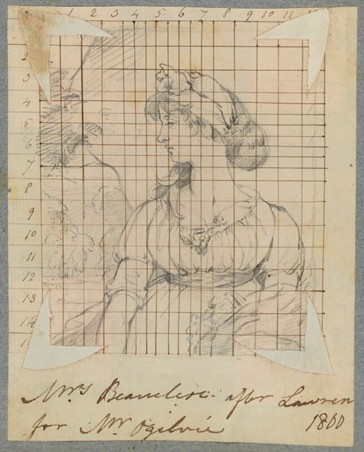
Henry Bone, after Sir Thomas Lawrence, Emily Charlotte Ogilvie Beauclerk (NPG D17273 © National Portrait Gallery, London)
Works Cited
Cline, Clarence Lee, Byron, Shelley and their Pisan Circle, Cambridge, Mass., Harvard University Press, 1952.
Crisafulli, Lilla Maria, “Introduction: Historical and Social Environment of The Liberal”, in Imprinting Anglo- Italian Relations in "The Liberal", eds Lilla Maria Crisafulli, Serena Baiesi and Carlotta Farese, Bern, Peter Lang, 2023, pp. 15-34.
Gisborne, Maria and Edward E. Williams, Maria Gisborne & Edward E. Williams: Shelley’s Friends, Their Journals and Letters, ed. Frederick L. Jones, University of Oklahoma Press, 1951.
Grylls, Rosalie Glynn, Trelawny, London, Constable, 1950.
Medwin, Thomas, The Life of Percy Bysshe Shelley, ed. Harry Buxton Forman, London, Oxford University Press, 1913.
Seymour, Miranda, Mary Shelley, London, John Murray, 2000.
Shelley, Mary, The Letters of Mary Wollstonecraft Shelley, vol. 1, ed. Betty T. Bennett, Baltimore and London, The Johns Hopkins University Press, 1980.
Shelley, Mary, The Journals of Mary Shelley, vol. 1: 1814-1822, eds Paula R. Feldman and Diana Scott-Kilvert, Oxford, Clarendon Press, 1987.
Shelley, Percy Bysshe, The Letters of Percy Bysshe Shelley, vol. 2, ed. Frederick L. Jones, Oxford, Clarendon Press, 1964.
Nicoletta Caputo, December 2025
Ultimo aggiornamento
25.09.2026