
The Pisan Salons: Elena Amati Mastiani Brunacci (1770-1849)
Nicoletta Caputo (University of Pisa)
The salon of the unconventional Elena Mastiani Brunacci opened in 1801 and soon became the centre of Pisa’s social life. As Andrea Addobbati informs us, “To gather the first group of loyal patrons, the woman, aided by a French officer and a Catholic priest, began organising a game of Biribissi in her salon” (Addobbati 2004, p. 75). Biribissi was a gambling game that fell somewhere between roulette and bingo. To avoid trouble with the authorities, Mastiani Brunacci set a very low limit (one lira) for the bets. This, however, was not enough, and, in 1806, she had to submit to the government a formal request for permission to allow her guests to play. In the Mastiani Brunacci salon, however, people did not meet only to gamble. Thus wrote the illustrious botanist Gaetano Savi in 1805: “the magnificence of the parties and the sweetness of the music attract the best of the cultured society, and among these pleasures, the kindness and the amiable manners of the one who presides over them with such taste is certainly not the least” (quoted in Addobbati 2004, p. 76). Elena was interested in literature, and in her youth she had been a member of the “Polentofagi Academy”, whose name derived from the custom of eating chestnut flour polenta during their literary meetings, which took place in Via Tavoleria, at the home of the doctor and scholar Francesco Masi.
Giovan Francesco Mastiani Brunacci, who in 1811 was awarded the prestigious title of Count of the Empire by Napoleon, had travelled with his wife to Paris in 1809-1810 as a Tuscan deputy. However, from the very beginning, well before this stay, Elena Mastiani Brunacci’s salon had conformed “to a model of sociality derived from France and conventionally based on female protagonism” (Addobbati 2004, p. 71). The “magnificent parties” Savi recalled included not only the local nobility but also the great Napoleonic nobility. The fortunes of the Mastiani Brunacci family did not change with the fall of the Emperor. The countess, who had been lady-in-waiting to Elisa Baciocchi in Lucca, was later lady-in-waiting to the Lorena family in Florence, and her Pisan salon remained a magnet not only for the local elite but also for passing travellers and literati. Madame de Staël, who spent several months in Pisa between 1815 and 1816, where she also frequented the Vaccà Berlinghieri family, found the Mastiani house “plus agréable que toutes celles de Florence” (Addobbati 2004, p. 78). The Mastiani Brunacci salon, which was to host Leopardi during his seven-month stay in Pisa in 1827-28, also hosted the Shelleys, who were introduced by the Irishman John Taaffe. Mary’s diary records a visit to Elena Mastiani on 28 July 1821 (“call on the Mastiani”), which was returned by “Mme Mastiani” two days later. (M. Shelley 1987, p. 375).
For the Mastiani Brunacci family, hospitality was a true mission. Their palace, luxuriously furnished and adorned with works by the most illustrious artists of the time, consisted of one hundred and eighteen rooms and included twenty salons. The Counts had an army of people under their command. In addition to the “general manager of the house”, they had “a maîtresse, three valets, sixteen generic servants, a cook, a gardener, three coachmen, and a groom” (Addobbati 2004, p. 77). As Addobbati, again, observes, such a large number of servants went far beyond the family’s needs and can only be explained by the obligation of hospitality towards the salon’s frequenters. Such a lifestyle was extremely expensive, but the Mastiani Brunacci had only one daughter who was “in an infelicitous state of mind” (Addobbati 2004, p. 72), and, consequently, they knew she would never marry and produce an heir. Thus, they had no one to preserve their fabulous wealth for.
Elena Mastiani Brunacci, however, was also a much-discussed woman, and contemporary documents dwell abundantly on her romantic liaisons. This is the portrayal – a much less flattering one than Savi’s – that a spy for the Grand Ducal government, Luigi Torelli, depicted:
His Wife then, who although Old, could not forget that she had been Young and a prostitute of all the Foreigners, in addition to having shown herself to be the gallant of all the Commissioners and Generals during the time of the French Government, in 1815 for having wanted to protect a French Police Inspector in spite of the Government, which had exiled him for the riots he had caused at the Theatre, was condemned by the Governor to House arrrest. (Qtd. in Panajia 2004, p. 95)
Apart from this ungenerous description, Torelli’s manuscript is of interest because it shows how the meetings in Elena Mastiani Brunacci’s salon were not just of a social nature, but, as was usually the case for the Shelleys and their friends too, were considered subversive:
These were introduced into the Mastiani House, where all the Sectarians, malcontents, and enemies of the Sovereigns used to gather, because the Count (by inclination fond of Baciocchi, who had taken refuge in his house for eight days when the English landed at Livorno and Viareggio) did not love the Grand Duke, although out of duty he showed himself subordinate to him; […] Countess Mastiani, having returned at this time from Florence, where she had remained for a long time, opened her usual scandalous Conversation, and on her little table, where she used to have the Minerva, La Voce del Secolo, together with the other Newspapers of the self-proclaimed Neapolitan Parliament, Lady Morgan’s Work had succeeded as the reading of the day. At this were being made by her, and by all the guests, hearty laughs on the diatribes spewed against all the Sovereigns and Ministers of Europe. This book was strictly forbidden, but who was to forbid it to a woman, like Mastiani, who outside of Fossombroni had all the Ministers at her disposal? (Qtd. in Panajia 2004, pp. 94-95)
Perhaps, the worst scandal to engulf this much-discussed noblewoman was linked to the death, in 1839, of her husband, whose will designated, as heir to the immense family fortune, the Bohemian Baron Teodoro Tausch, Ottoman Consul in Livorno, who was believed to be Countess Elena’s lover. It was said, in fact, that Count Giovan Francesco’s will had been drawn up after his death, and that the notary had shown the document to the now deceased count, who was made to nod his head by hidden strings, like a puppet (Addobbati 2004, p. 72).
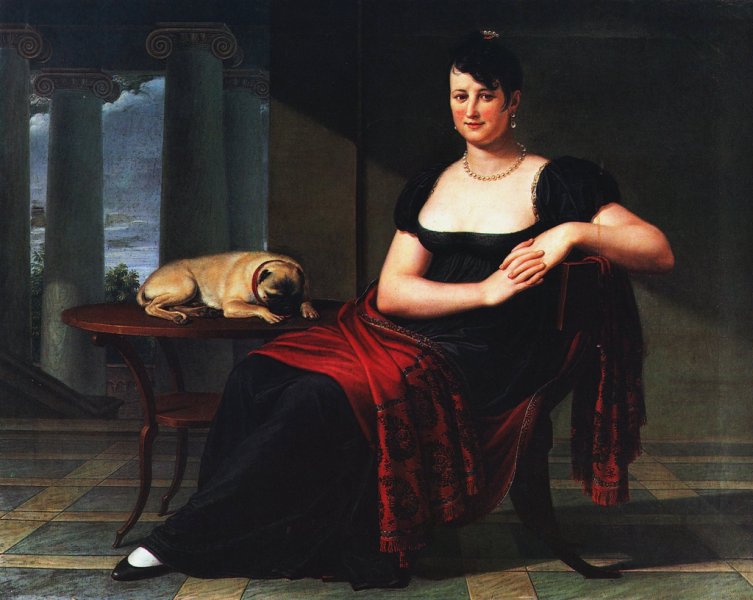
Pietro Benvenuti, Elena Mastiani Brunacci, 1809 (Firenze, Galleria Pitti, Wikimedia Commons)
Works Cited
Addobbati, Andrea, “La contessa Mastiani Brunacci e il suo salotto”, in L’Università di Napoleone. La riforma del sapere a Pisa, a cura di Romano Paolo Coppini, Alessandro Tosi e Alessandro Volpi, Pisa, Edizioni Plus, 2004, pp. 71-80.
Panajia, Alessandro, “Nobili, ‘dame’ e ussari a Pisa in periodo napoleonico”, in L’Università di Napoleone. La riforma del sapere a Pisa, a cura di Romano Paolo Coppini, Alessandro Tosi e Alessandro Volpi, Pisa, Edizioni Plus, 2004, pp. 93-110.
Shelley, Mary, The Journals of Mary Shelley, vol. 1: 1814-1822, eds Paula R. Feldman and Diana Scott-Kilvert, Oxford, Clarendon Press, 1987.
Nicoletta Caputo, December 2025
All the English translations from Italian are by the author of the present essay
Ultimo aggiornamento
25.01.2026