
George Frederick Nott, Mary Shelley and the Pisan Circle
Fernando Cioni (University of Florence)
In his poem dedicated to George Frederick Nott, Byron ironically asks: “Do you know Doctor Nott?” (Byron 1991, 513). As Stefano Villani remarks, Nott “reflected the intellectual climate of his time and bridged English and Italian cultures at the turn of the 19th century” (2012, 785). Nowadays, as Rosemary Mitchell suggests in her entry in the second edition of The Dictionary of National Biography, Nott is remembered mostly in connection to his work as editor of the poems of Sir Thomas Wyatt and those of Henry Howard, Earl of Surrey. His edition of Surrey’s works remained the editio princeps until the appearance of the 1920s edition. In his own 1964 edition, Emrys Jones commends both its editorial framework and its philological care. Both Mitchell's entry (2004) and that of Sidney Lee in the first edition of The Dictionary of National Biography (1894) focus on a few details of Nott's life, briefly underlining periods of his life, alternating between the Anglican ministry and literary and artistic scholarship, and between his English and Italian stays.
Nott arrived in Pisa in 1821 and resided in the same house where Percy Bysshe Shelley and Mary Godwin lived upstairs. The relationship between the Shelleys and Nott was stormy to say the least; and Lord Byron, too, who arrived in Pisa in the same year, had a conflictual relationship with Nott. In 1822, Nott visited Naples and Sicily; he was in Florence in 1823; and moved to Rome in 1824, where he quickly became part of the city’s cultural circles. After a two-year period in England (1824-1826), he returned to Italy, where he met Vincenzo Monti in Milan (1826) and Giacomo Leopardi in Florence (1827). In Naples he published an edition of the Divine Comedy (1828), with commentary and notes, and in 1832 the Italian translation of the Book of Common Prayer, an attempt, as Stefano Villani notes, "to present the Church of England to Italians as a potential model for religious and and political reform" which had little real impact on Italian history" (2022, XV).
In Pisa in 1821, Nott rented an apartment in the “Tre Palazzi di Chiesa” on the Lungarno, and, from the beginning of his stay, used it to host Sunday chapel services for the Pisan English community. The English traveller Selina Martin writes enthusiastically of Dr Nott’s services at “Casa Chiesa” in the diary recording her three-year residence in Italy:
Sunday, 16th. The children and I went to church to-day, and heard our liturgy most beautifully and impressively read by Doctor Nott, who afterwards preached an excellent sermon, I say church because, though the service was performed in the clergyman's private apartments, the house is called Casa Chiesa, very appropriately, being now the Church of the English; all of whom are invited to attend, and all do very regularly, except Lord Byron and some of his associates. (Martin 1831, 372)
Christmas Day. We attended divine service and the Sacrament administered by Dr. Nott. The mercy of God has again brought us to the celebration of this festival. (Martin 1831, 735)
When Nott started his Sunday chapel services, Mary and Percy went to live in the apartment above his on 25 October 1821. However, they did not attend Nott’s services: after all, Percy had been expelled from Oxford in 1811 after the publication of The Necessity of Atheism.
A few weeks after their arrival, Dr. Nott became the talk of the town for a supposed remark about Shelley, whom he is said to have called, punningly, “scelerato” (“scoundrel”). Mary reports this episode in a letter to Maria Gisborne:
To Maria Gisborne Pisa Jany [?-] 18 1822
In the piano sotto di nos there is a Reverend Divine who preaches and prays, and sent me so many messages that I now make one of his congregation, and that from a truly Christian motive—Vacca reported that this Doctor Nott said in Society that Shelley was a scelerato. We told Taaffe and the little gossip reported it to all the world. Doctor Nott heard of it, and sent a message by Medwin to deny it, and put our absence from Church on the score of this report. (1980, 214)
In the same letter, Mary writes: “to prove that I forgave or disbelieved, I went once, and then that I might not appear to despise his preaching, I went again and again.” Mary attended Nott’s chapel services the first time on 9 December 1821, as she records in her journal, and probably another three times on 30 December 1821, 3 March 1822, and 24 March 1822. On 30 December 1821 she participated in the christening of the Williams’s daughter, Rosalind, as her godmother. In her journal, Maria Gisborne writes:
Sunday, December 30. Wind unabated but the weather still cloudy and cold. From the tremendous rain of yesterday the Arno has risen still higher and continues to threaten the destruction of the bridge. The water has made some progress into the town. After church the Reverend Dr. Nott christened our little girl—Mary being her godmother. (1951, 121)
Mary’s attendance at Nott’s services, as Lucy Maddox Brown Rossetti writes, “caused commotion”:
At one time Mary caused a commotion by attending Dr. Nott's Sunday service, which was held on the ground floor of her house. On one occasion he preached against Atheism, and, having specially asked Mary to attend, it was taken as a marked attack on Shelley, and it was considered that Mary had taken part against her husband. (1890, 159)
In a letter from London to Mary, dated 9 February 1822, Maria Gisborne reported Thomas Jefferson Hogg’s reaction to her attendance at Nott’s services:
Your friend Hogg is molto scandalizzato to hear of your weekly visits to the Piano di sotto; he does not allow that he ever had a dislike to Lord Byron, but yet he classes him with the rest of the moderns, of whom he has so indifferent an opinion, that he thinks them scarcely worth the trouble of reading. [1951, 78)
In turn, in a letter of 7 March 1822, Mary reacted to Hogg’s regret:
To Maria Gisborne Pisa March 7^ 1822
So Hogg is shocked that for good neighborhoods sake I visited the piano di sotto —let him reassure himself, since instead of a weekly it was only a monthly visit—in fact after going 3 times I staid away until I heard he was going away- (1980, 223)
In a sermon attended by Mary, Dr Nott preached against atheism, and she felt that his remarks were directed at Shelley. In the same letter to Maria Gisborne, Mary writes:
—he preached against Atheism—& they said against S. as he invited me himself to come this appeared to me very impertinent so I wrote to him to ask him whether he intended any personal allusion, but he denied the/ charge most entirely—this affair as you may guess among the English at Pisa made a great noise—the gossip here is of course out of all bounds, some people have given them something to talk about. (1980, 223)
In another letter to John Cam Hobhouse, Mary reports that “Medwin could also have mentioned that as soon as Dr Nott heard that he was accused of the impropriety of preaching against Shelley, he paid us a visit to exculpate himself from the charge” (1980, 455).
During this proliferation of gossip, also Lord Byron was in Pisa, having arrived there at the end of October. As Medwin writes, Byron was upset to hear of Nott’s supposed attacks against Shelley. If the latter laughed at the pun on his name (“Shelley/scellerato), Byron, punned on Nott’s name: “Thou shalt, Nott, bear false witness against thy neighbour” (1913, 361), reverting the biblical say “Thou shalt not bear false witness against thy neighbour,” (Exodus 20:16). Also, in a letter to Thomas Moore from Pisa, dated 20 February 1822, Byron complains about the Anglican parsons’ attacks on his Cain, including the parson in Pisa – that is, Dr Nott:
There is nothing against the immortality of the soul in Cain that I recollect. I hold no such opinions; — but, in a drama, the first rebel and the first murderer must be made to talk according to their characters. However, the parsons are all preaching at it, from Kentish Town and Oxford to Pisa, —the scoundrels of priests, who do more harm to religion than all the infidels that ever forgot their catechisms. (1979, 111)
Teresa Guiccioli, in her memoirs of Lord Byron’s life in Italy, reports the poet’s reaction to Nott’s attack:
I am less sensitive than you, Lord Byron remarked, because I heard that a fortnight ago this same person threw out strong innuendos against me, echoing the other clergyman from Kentish Town with enthusiasm and preaching against Cain. He took as his excuse what I say, in a very orthodox way, about the serpent who tempted Eve – thus clearing up other disputed points – so that he could preach against me and abuse me. It’s a dangerous game he's playing there. People who live in glass houses as he does, shouldn’t throw stones – because he might be afraid I would write his life, which I know about; if I haven't done so, it’s because I am not vindictive. (2005, 416)
Unlike Shelley, Byron did not laugh off Dr. Nott’s words (Buxton 1968, 200), and instead responded with a satirical song, “A New Song to the Tune of ‘The Vicar and Moses’” (Byron, 1991, 513-515). The poem’s MS in the Murray Archive has the following endnote:
Pisa, March 3rd, 1822. These lines (not intended for publication) were written at a parson who preached personal Sermons upon me & others; I have thrown all the Pulpits (it seems) into hysterics from Pisa to Paddington. (Byron, 1991, 725)
In his poem Byron parodies the famous eighteenth-century satirical song “The Vicar of Bray”, which deals with a clergyman who, in order to maintain his position, adjusts his religious beliefs whenever a new King or Queen ascends the throne:
And Damn'd are those who dare resist,
Or touch the Lord's Anointed.
And this is law, I will maintain
Unto my Dying Day, Sir.
That whatsoever King may reign,
I will be the Vicar of Bray, Sir!
Byron adapted the song to mock Nott’s hypocrisy. And in its first stanza he goes back to the then much discussed scandal at court involving Nott and the Princess Charlotte:
A New Song to the Tune of the 'Vicar and Moses.'
I.
Do you_ know Doctor Nott
With 'a crook in his lot,'
Who seven years since tried to dish up
A neat Codicil
To the Princess's Will,
Which made Dr. Nott not a Bishop?
As Jerome McGann argues, Byron
[…] takes off from the gossip which circulated about Nott during his time with the Princess Charlotte, who became infatuated with Nott and, on being reproved by her grandmother the Queen, threatened to make over to him all her personal property. Scandal had it that Nott was trying to use Princess to gain church preferment as well. (McGann 1991, 724-725)
Byron continues his defamation of Nott, underlying how, after having failed as a teacher, he “reinvented” himself as a “Preacher:
2.
So the Doctor being found
A little unsound
In his doctrines at least as a teacher,
And kicked from one stool
As a knave or a fool,
He mounted another as Preacher.
Nott is a Preacher who “’Gainst Freetinkers’, he roars” (line 19) and “dishonour[s] the Cause of Devotion” (line 30); and, in the seventh stanza, Byron addresses himself directly to Nott, who, being a sinner himself, cannot condemn “what sin does” (42). The line “He should never throw stones who has windows / Of Glass to be broken,” (39-40) mirrors precisely the expression recorded by Teresa Guccioli and quoted above. And if, in that context, the line sounded like a menace (that is, “Do not criticize or slander another if you are vulnerable to retaliation”), here the entire song articulates that menace:
7.
But, Doctor, one word,
Which perhaps you have heard,
'He should never throw stones who has windows
Of Glass to be broken,'
And by this same token,
As a Sinner, you can't blame what Sin does.
The last stanza contains Byron’s final attack on Nott, in which the clergyman is “demoted” from bishop to backbiter:
9.
Though your Visions of Lawn
Have been lately withdrawn,
And you missed your bold stroke for a Mitre,
In a snug little way
You may still preach and pray,
And from Bishop sink into Backbiter.
The Nott “case” was surely incidental to the season of the Pisan circle. Yet reconstructing it through the voices of its protagonists offers a glimpse of the intellectual, and partly tragicomical, climate in which it arose.
REFERENCES
Buxton, John, Byron and Shelley; The History of a Friendship, London, McMillan, 1968.
Byron, George, “In the wind’s eye”. Byron’s Letters and Journals, vol. IX. ed. Leslie A. Marchand, Cambridge (MASS), The Belknap Press of Harvard University Press, 1979
Byron, Lord, The Complete Poetical Works, vol. VI, ed. Jerome J. McGann and Barry Weller, Oxford, Oxford University Press, 1991.
Cline, C.L., Byron and Shelley and the Pisan Circle, London Murray, 1952
Gisborne, Maria, and Edward E. Williams. Shelley’s Friends: Their Journals and Letters. Ed. Frederick L. Jones. Norman, University of Oklahoma Press, 1951.
Guiccioli, Teresa, Lord Byron’s Life in Italy, trans. Michael Rees, ed. Peter Cochran, Newark, Delaware, University Press, 2005.
Lee, Sidney, George Frederick Nott, in Dictionary of National Biography, 1894.
Martin, Selina, Narrative of three years’ residence in Italy 1819-1822, Dublin, Wakeman, 1831.
Medwin, Thomas, The Life of Percy Bysshe Shelley (1847), London, Oxford University Press,1913.
Mitchell, Rosemary, George Frederick Nott, in Dictionary of National Biography, 2016 (2004).
Rossetti Maddox Brown, Lucy, Mrs. Shelley, London, Allen & Co., 1890.
Shelley, Mary, The Letters, vol. 1, ed. Betty T. Bennett, Baltimore and London, John Hopkins University Press, 1980.
Shelley, Mary, The Journal of Mary Shelley, ed. Paula R. Feldman and Diana Scott-Kilvert, Oxford, The Clarendon Press, 1987.
Villani, Stefano, George Frederick Nott (1768-1841). Un ecclesiastico anglicano tra teologia, letteratura, arte, archeologia, bibliofilia e collezionismo, Roma, Scienze e Lettere, 2012
Villani Stefano, Making Italy Anglican, Oxford, Oxford University Press, 2022.
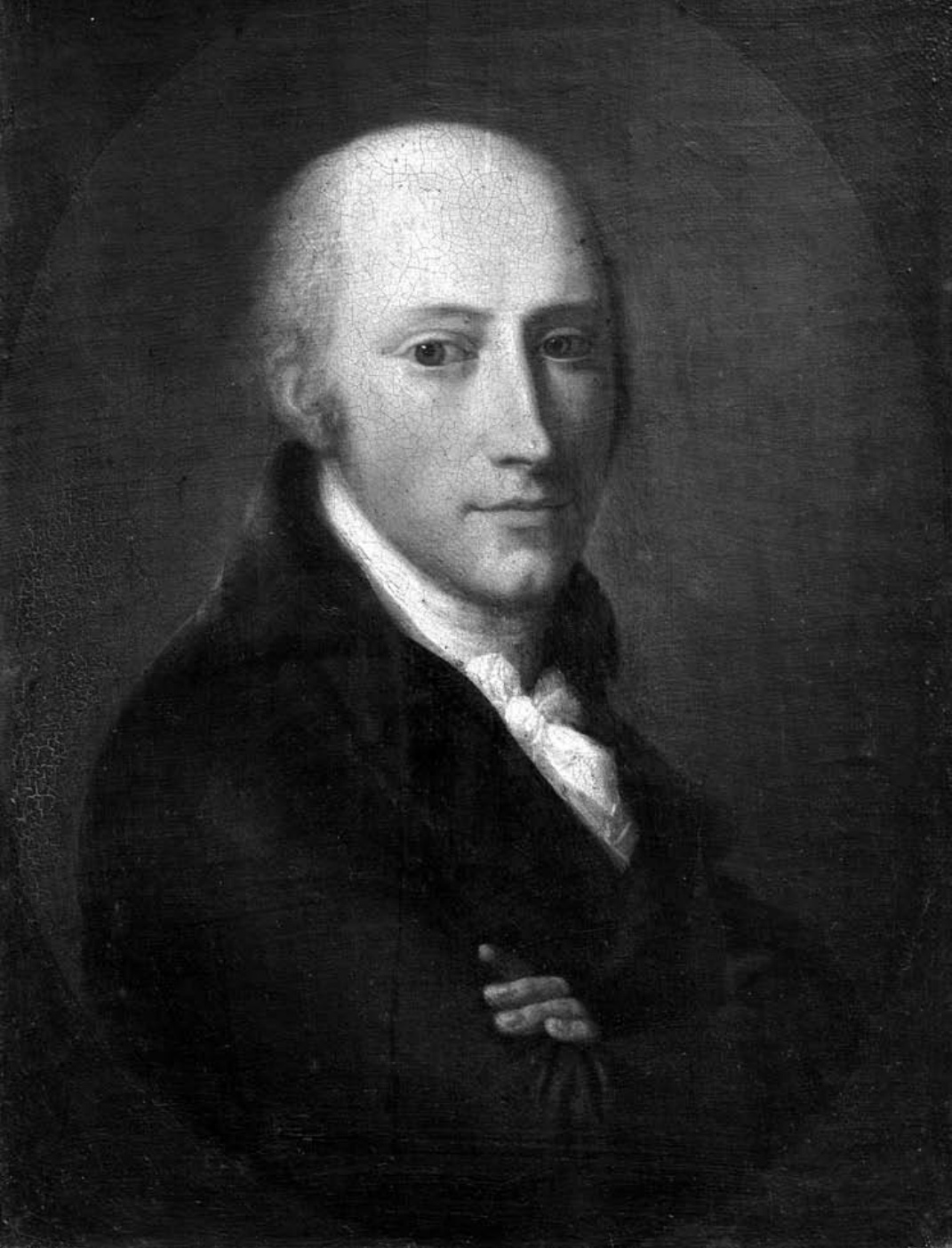
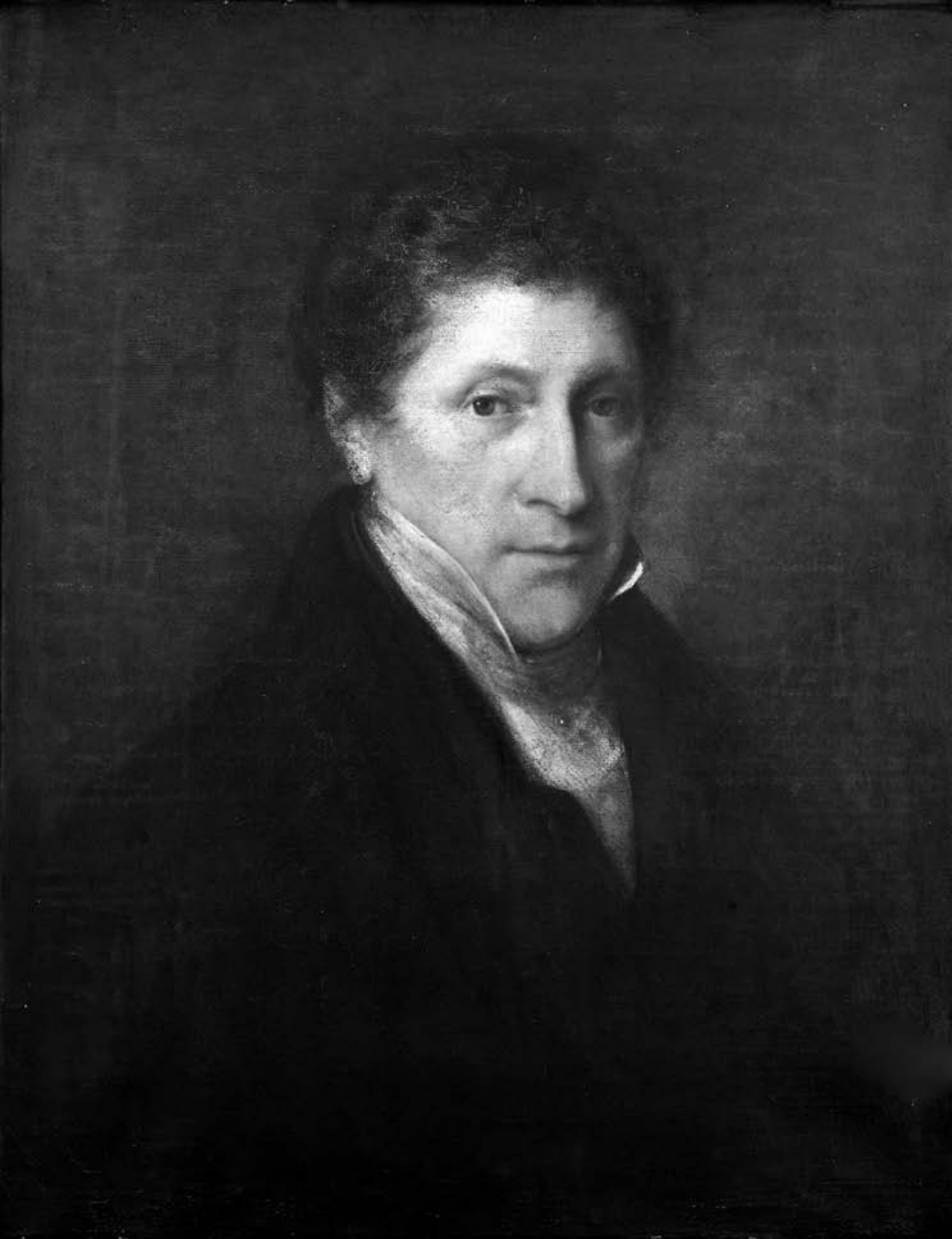
Portrait of George Frederick Nott (1829), Winchester Cathedral Collection, “Reproduced with the permission of the Dean and Chapter of Winchester Cathedral”.
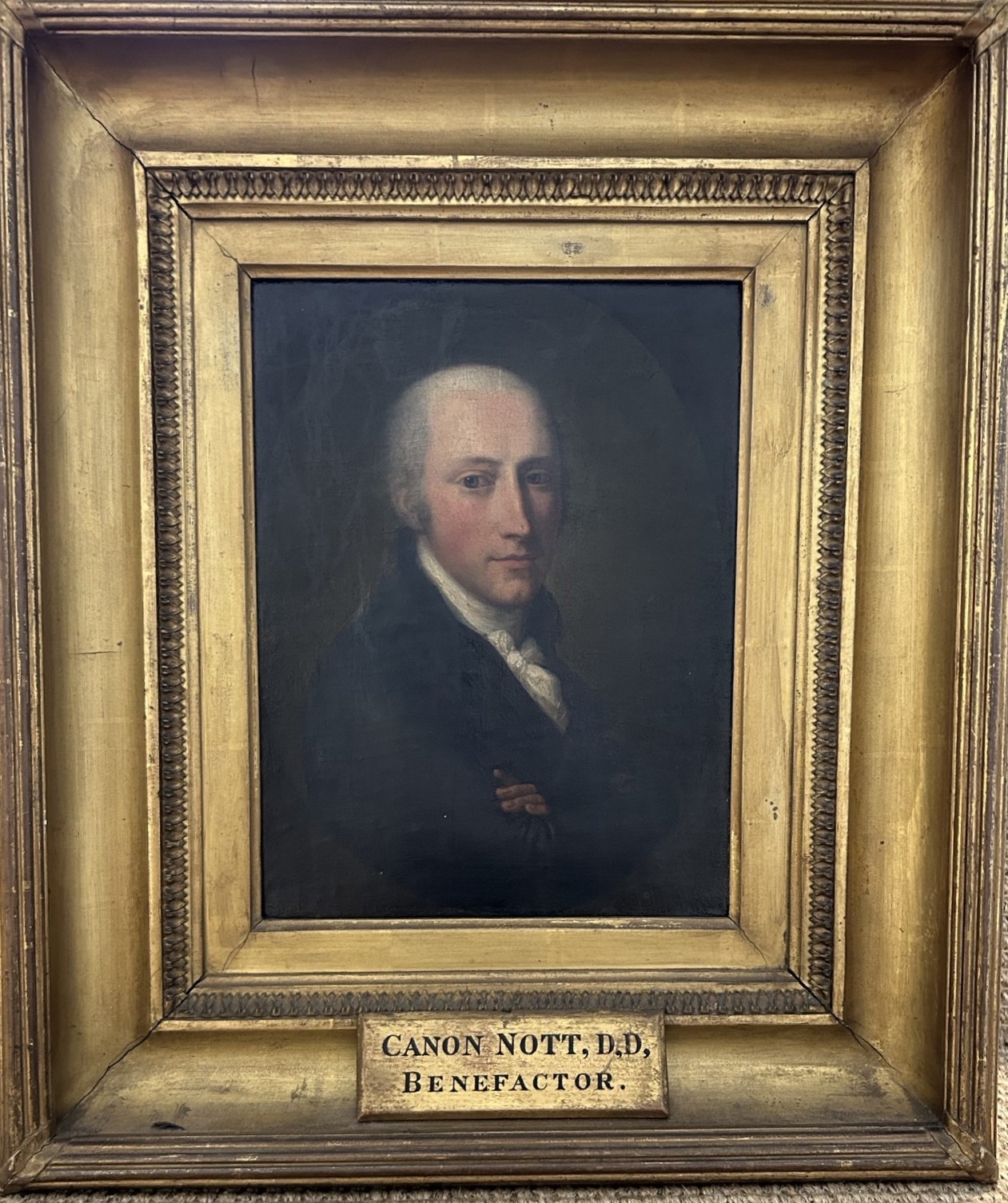
Portrait of George Frederick Nott (a. 1806), Winchester Cathedral Collection, “Reproduced with the permission of the Dean and Chapter of Winchester Cathedral”.
Ultimo aggiornamento
20.09.2026